HDU4822 Tri-war

三色**

首先考虑两种颜色,分别在uv
由于路径唯一,两种颜色还是比较好求的
只要取$\left ( u,v \right )$路径中点,将树分为两半即可,每个点分别控制一半
如图
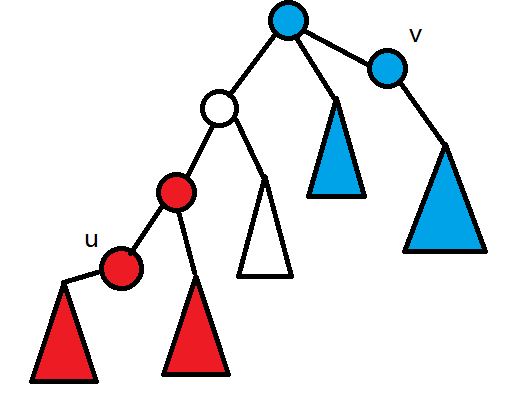
double

现在有三种颜色,也就是求交集
求交集可以用线段树,先把树转化为dfs 序,然后第一次区间加,第二次区间询问

不知道为什么写挂了,于是写了个分类讨论
记录一个二元组$\left ( opt,x \right )$,$x$为子树根节点,$opt=1$表示可选,0 则表示不可选
观察到两棵子树之间只有两种关系,要么不相交,要么一棵树是另一棵树的子树
判断是否相交用$LCA$即可
然后分类讨论,设两棵子树分别以$A$,$B$为根,且$A_{sz}\leq B_{sz}$

  • 均可选,若两棵子树不相交则为0 ,否则为$A_{sz}$
  • 均不可选,若两棵子树不相交则为$n-A_{sz}-B_{sz}$,否则为$B_{sz}$
  • 一个可选,一个不可选

    设$A_{opt}=1$,$B_{opt}=0$,这里对$sz$没有要求

    • $LCA\left ( A,B \right )=A$,答案为$A_{sz}-B_{sz}$
    • $LCA\left ( A,B \right )=B$,答案为0 ,但事实上并不会出现这种情况
    • 否则为$A_{sz}$
1
2
3
4
5
6
7
8
9
10
11
12
13
14
15
16
17
18
19
20
21
22
23
24
25
26
27
28
29
30
31
32
33
34
35
36
37
38
39
40
41
42
43
44
45
46
47
48
49
50
51
52
53
54
55
56
57
58
59
60
61
62
63
64
65
66
67
68
69
70
71
72
73
74
75
76
77
78
79
80
81
82
83
84
85
86
87
88
89
90
91
92
93
94
95
96
97
98
99
100
101
102
103
104
105
106
107
108
109
110
111
112
113
114
#include<cstdio>
#include<vector>
#include<cstring>
#include<algorithm>
using namespace std;
const int N=1e5+50,rt=1;
struct node{int opt,x;};
int fa[N][25],log[N],sz[N],dep[N],n,m;
vector<int> e[N];
inline int read()
{
register int x=0,t=1;
register char ch=getchar();
while (ch!='-'&&(ch<'0'||ch>'9')) ch=getchar();
if (ch=='-') t=-1,ch=getchar();
while (ch>='0'&&ch<='9') x=x*10+ch-48,ch=getchar();
return x*t;
}
void dfs(int o)
{
sz[o]=1;
for(int i=1;i<=log[dep[o]];i++)
fa[o][i]=fa[fa[o][i-1]][i-1];
for(int i=0;i<e[o].size();i++)
{
int to=e[o][i];
if (!dep[to])
{
dep[to]=dep[o]+1;
fa[to][0]=o;
dfs(to);
sz[o]+=sz[to];
}
}
}
int update(int x,int k)
{
for(int i=0;i<=log[k];i++)
if ((k>>i)&1) x=fa[x][i];
return x;
}
int LCA(int u,int v)
{
if (dep[u]<dep[v]) swap(u,v);
u=update(u,dep[u]-dep[v]);
if (u==v) return u;
for(int i=log[dep[u]];i>=0;i--)
if (fa[u][i]!=fa[v][i])
u=fa[u][i],v=fa[v][i];
return fa[u][0];
}
node find(int u,int v,int pre)
{
int len=dep[u]+dep[v]-dep[pre]*2;
if (dep[u]>=dep[v])
return (node){1,update(u,(len-1)/2)};
else
return (node){0,update(v,len/2)};
}
int calc(int x,int u,int v)
{
node A=find(x,u,LCA(x,u));
node B=find(x,v,LCA(x,v));
if (A.opt&&B.opt)
{
if (dep[A.x]<dep[B.x]) swap(A,B);
if (LCA(A.x,B.x)!=B.x) return 0;
return sz[A.x];
}
else if (!A.opt&&!B.opt)
{
if (dep[A.x]<dep[B.x]) swap(A,B);
if (LCA(A.x,B.x)!=B.x)
return n-sz[A.x]-sz[B.x];
else
return n-sz[B.x];
}
else
{
if (!A.opt) swap(A,B);
int pre=LCA(A.x,B.x);
if (pre==A.x) return sz[A.x]-sz[B.x];
return sz[A.x];
}
}
int main()
{
int T=read();
for(int i=1;i<N;i++)
log[i]=log[i-1]+(1<<log[i-1]==i);
while (T--)
{
n=read();
for(int i=1;i<=n;i++) e[i].clear();
memset(dep,0,sizeof(dep));
memset(fa,0,sizeof(fa));
for(int i=1;i<n;i++)
{
int u=read(),v=read();
e[u].push_back(v);
e[v].push_back(u);
}
dep[rt]=1,dfs(rt);
m=read();
for(int i=1;i<=m;i++)
{
int a=read(),b=read(),c=read();
printf("%d ",calc(a,b,c));
printf("%d ",calc(b,a,c));
printf("%d\n",calc(c,a,b));
}
}
return 0;
}